ScoutLane — Evidence-Led Recruitment Platform
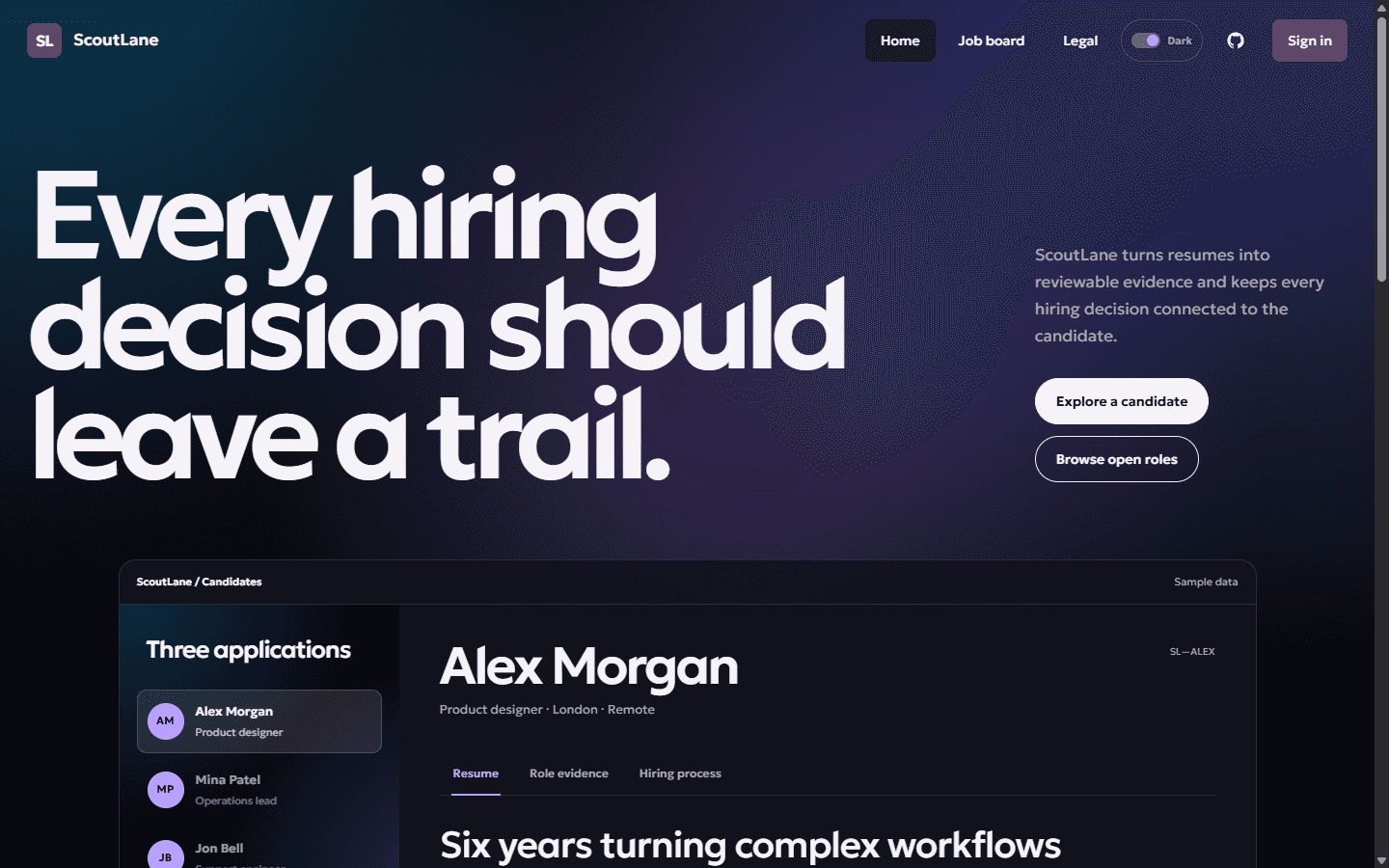
ScoutLane turns resumes into reviewable evidence and keeps every hiring decision connected to the candidate.
Public release
Compare a resume with a job description. The public tool checks source excerpts and keeps resume matching separate from hiring records.
Try Resume Match ↗Status documented
Overview
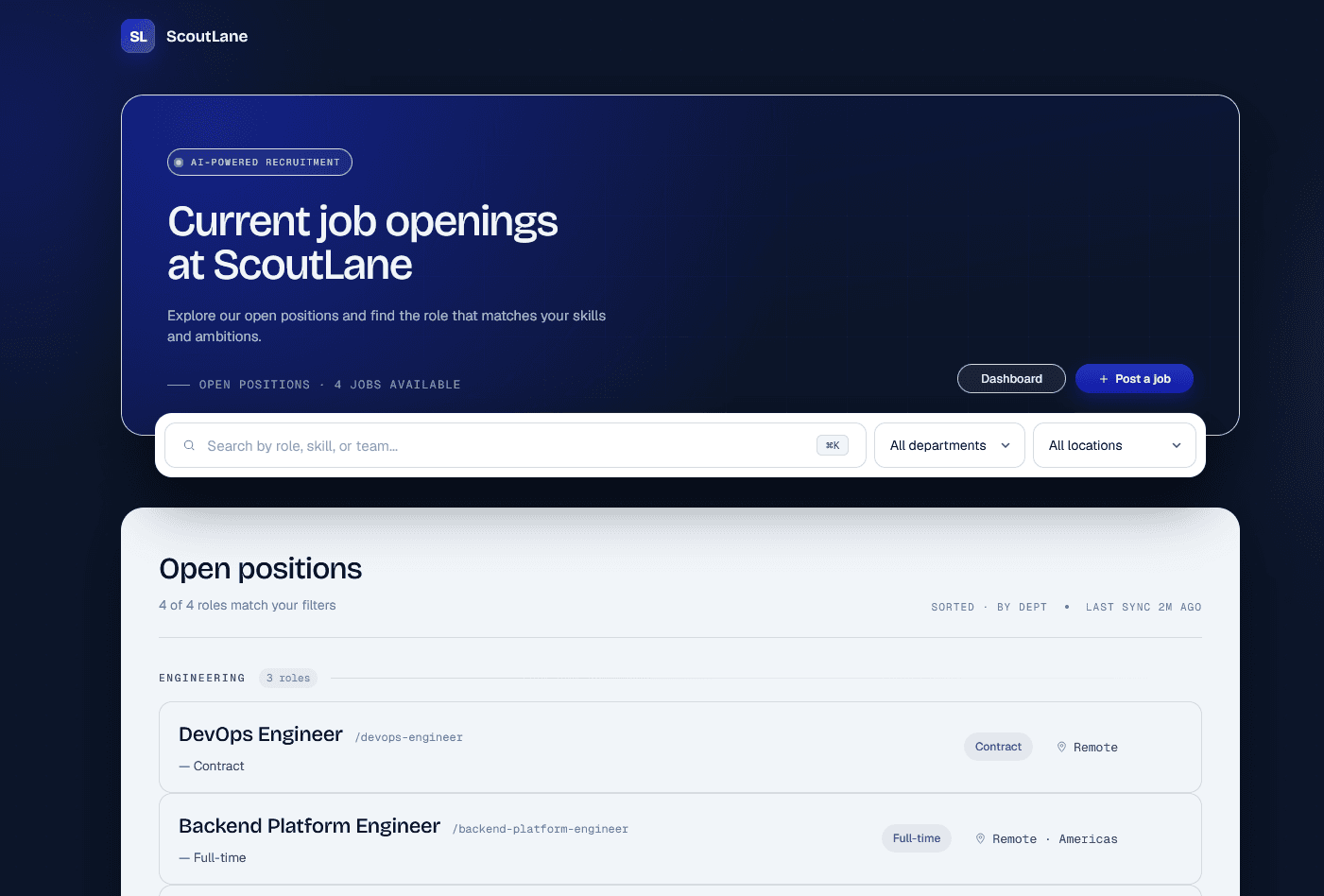
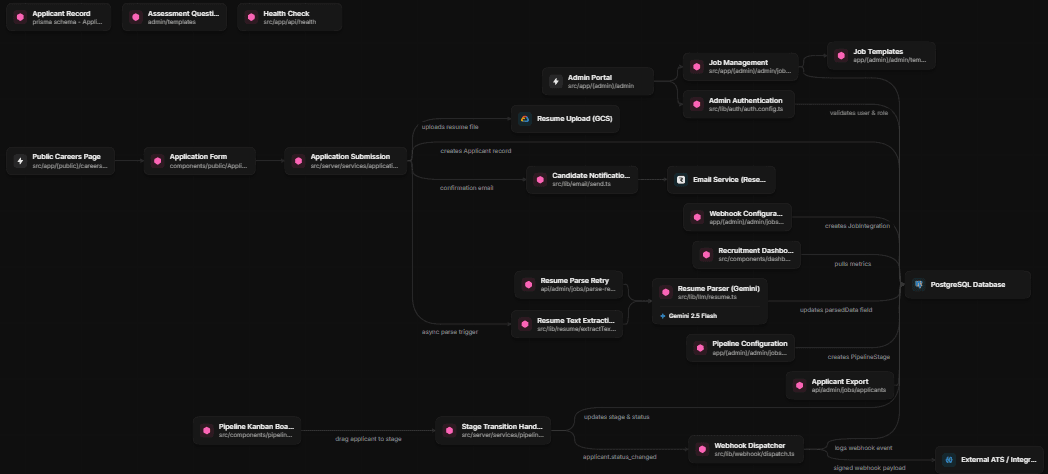
ScoutLane is an evidence-led recruitment platform built around a simple rule: every hiring decision should leave a trail. Its public experience presents open roles and an interactive candidate record; the operational product combines resume parsing, structured evidence, drag-and-drop pipelines, role-based access, analytics, job templates, and the production infrastructure — async workers, transactional email, cloud storage, and signed outbound integrations — a hiring team needs day to day.
The Problem
Recruitment teams spend hours manually reviewing resumes and tracking candidates across spreadsheets. ScoutLane automates resume parsing and provides structured pipeline management to reduce time-to-hire, without leaving the operational gaps — auth, permissions, notifications, integrations — that turn a demo into unshippable software.
Questions Addressed
- 01
How can AI reliably extract structured data from unstructured resumes?
- 02
What pipeline views give recruiters the best visibility into candidate progress?
- 03
What does a resume-parsing pipeline need beyond the happy path to run unattended — retries, async workers, role separation?
Methodology
Resume Parsing Engine
Built an AI-powered resume parser (OpenRouter, model-configurable) that extracts education history, work experience, skills, and contact information from uploaded PDFs and DOCX files, normalized into structured candidate profiles and processed asynchronously via pg-boss workers so a slow parse never blocks the application flow.
Job Portal & Applications
Built public-facing career pages with department/location filters and custom application forms per job template. Candidates upload resumes which are automatically parsed and routed to the correct pipeline stage; Resend handles transactional email confirmations.
Admin Dashboard, RBAC & Integrations
Built a Clerk-authenticated admin dashboard with Admin, Recruiter, Hiring Manager, and read-only Guest paths; drag-and-drop Kanban pipelines; Recharts analytics; template and team management; and signed outbound integrations. The 2026-09-11 production checkpoint passed lint, typecheck, 544 tests with one skip, migrations, and the production build.
Key Results
Key Findings
AI resume parsing reduced manual data entry by ~80%, letting recruiters focus on candidate evaluation.
Kanban pipeline views improved team visibility into bottlenecks — stuck candidates became immediately visible.
Moving resume parsing to async pg-boss workers kept the application flow fast regardless of AI response latency — a lesson the earlier synchronous design didn't survive under real load.
Role-based access and an intentionally read-only guest path matter more than any single feature — hiring teams need permission boundaries before they can trust a tool with candidate data.
Conclusion
ScoutLane bridges AI-assisted evidence extraction and accountable human judgment. The evidence-led public experience and production application are live at scoutlane.net, backed by tested auth, role boundaries, async workers, email, storage, integrations, and deployment checks rather than a presentation-only demo.